01Why defaults matter more than docs
Self-hosting an LLM stack has never been easier: helm install ollama, helm install open-webui, done. But ease of install is not the same as ease of securing. Most of these services were designed as local tools — Ollama has no authentication mechanism at all, MLflow ships without built-in auth, Ray's dashboard famously answers every request — and the chart is often the first thing standing between that design and a routable IP address.
The interesting number is not "how many charts are insecure". It is how far the default values are from an unauthenticated, internet-reachable AI service — because that distance is what a tired engineer closes at 11pm when the demo must work by morning.
02Method, in one paragraph
I searched the Artifact Hub API with 52 AI/LLM terms (ollama, vllm, open-webui, langflow, mlflow, jupyter, qdrant, milvus, weaviate, ray, ...), deduplicated by repository+chart, and pulled the default values.yaml for each chart — HTTP tarballs directly, OCI charts (Bitnami and friends) via helm show values. A deterministic classifier then flagged network exposure (service.type: LoadBalancer/NodePort, ingress/httproute/gateway.enabled: true, with ancestor enabled: false gates respected) and authentication configuration. Finally I joined the charts with an upstream-auth table — what each service offers upstream, with sources — because a chart cannot configure an auth mechanism its app does not have. Every flagged chart was verified by hand.
03The numbers
| Metric (399 AI-relevant charts) | Count | % |
|---|---|---|
| Service exposed to the network at default values | 42 | 10.5% |
| Exposed + no auth config + upstream auth off/absent | 18 | 4.5% |
| Zero auth-related keys in chart defaults | 220 | 55.1% |
| One flag away: exposure knob + no auth + upstream auth off | 65 | 16.3% |
That last row is the one to sit with: a third of the charts could be exposed with a one-line change, and they contain no authentication configuration to turn on. helm install ollama-helm/ollama (57★) gives you a ClusterIP service and zero auth keys; flipping ingress.enabled=true yields an unauthenticated inference API on the internet — which is exactly the shape of the ~300,000 exposed Ollama deployments the "Bleeding Llama" advisories describe (CVE-2026-7482 and friends).
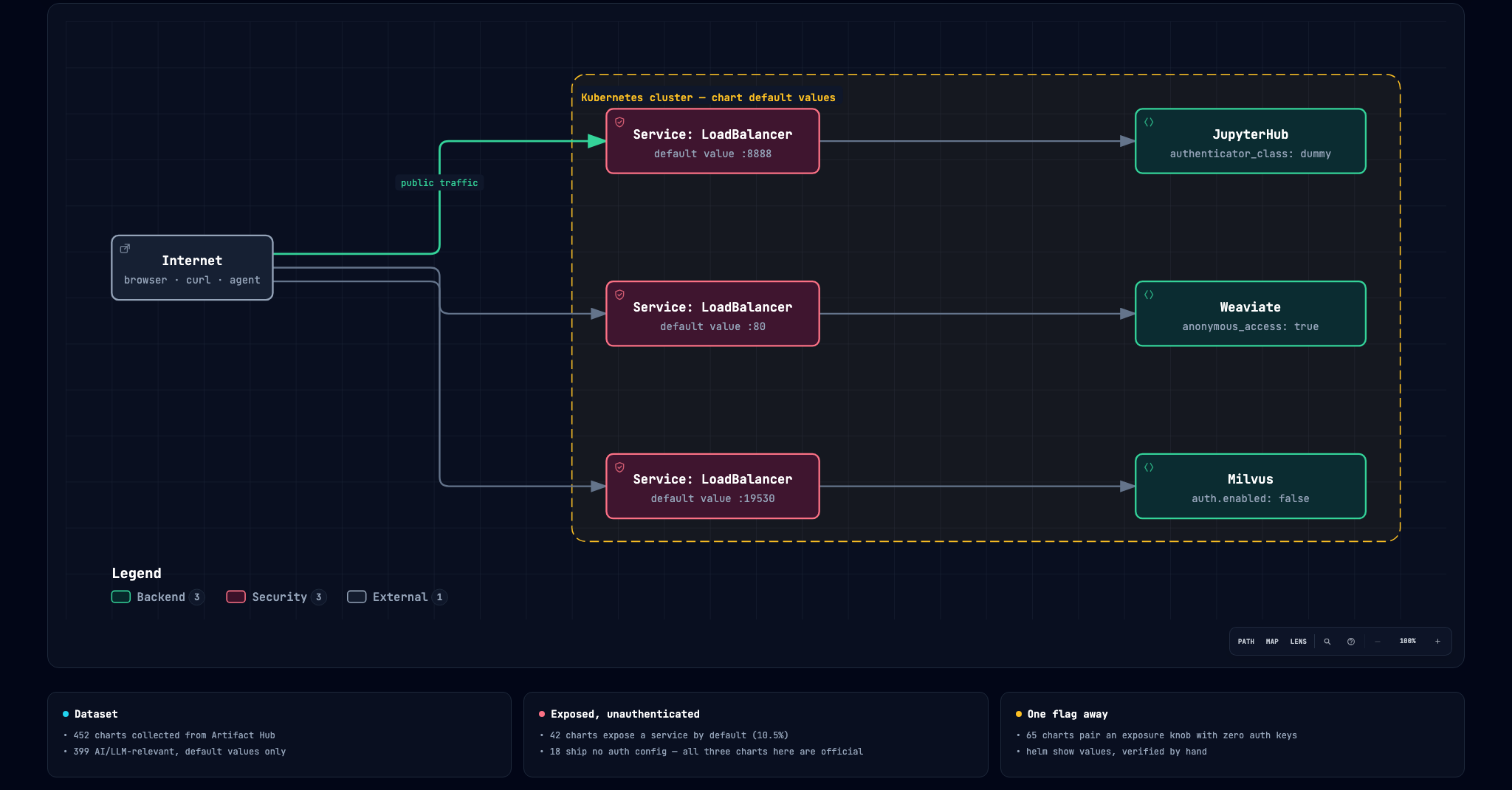
helm install: the exposure path for three official charts — interactive version (pan, zoom, theme, trace)04The three official charts worth staring at
None of these are obscure forks. They are the charts you land on first.
JupyterHub (77★, the official Zero-to-JupyterHub chart)
proxy:
  service:
    type: LoadBalancer        # exposed by default
hub:
  config:
    JupyterHub:
      admin_access: true
      authenticator_class: dummy   # accepts any username
The dummy authenticator is the documented default so that a first install works out of the box; the docs say plainly it should never run in production. The combination with a default LoadBalancer is what makes it notable: helm install plus nothing else produces an internet-reachable notebook server that lets anyone in.
Weaviate (official chart)
service:
  type: LoadBalancer                 # exposed by default
authentication:
  anonymous_access:
    enabled: true                    # anonymous by default
Anonymous access is the default and API keys / OIDC are opt-in. The upstream docs call this out; the defaults still speak for themselves.
Milvus (official Bitnami chart, OCI)
proxy:
  service: { type: LoadBalancer }    # data plane, exposed
attu:
  service: { type: LoadBalancer }    # web console, exposed
milvus:
  auth: { enabled: false }           # auth disabled by default
Both the gRPC data plane and the Attu web console ship as LoadBalancers while authorization is off — with stock values, a fresh Milvus asks nobody for credentials.
Fair framing
Most of these charts document that you must configure authentication for production, and maintainers are explicit about it. The finding is not "the chart authors are wrong" — it is that the defaults are the de-facto configuration for a large share of installs, and across the ecosystem those defaults converge on "open".
05Patterns by service family
| Family | Charts | Zero auth config | Exposed by default | Upstream auth |
|---|---|---|---|---|
| mlflow | 26 | 16 | 5 | none (basic-auth plugin / proxy required) |
| jupyter / jupyterhub | 37 | 11 | 10 | optional (dummy token/authenticator defaults) |
| kserve | 13 | 12 | 1 | none (expects gateway auth) |
| ollama | 7 | 6 | 0 | none at all |
| vllm | 9 | 7 | 0 | optional api-key |
| weaviate | 6 | 2 | 2 | optional (anonymous by default) |
| dify / librechat / langfuse | 17 | 3 | 4 | built-in accounts |
The contrast row matters as much as the offenders: apps with built-in account systems (Dify, LibreChat, Langfuse) expose their UIs happily — because the app authenticates. The problem is concentrated where the service has no auth story and the chart dutifully ships the exposure knob anyway. Ray is the loudest example: every KubeRay chart I scanned is zero-auth, and Ray's dashboard RCE (CVE-2025-62593) sat in CISA's Known Exploited Vulnerabilities catalog in August 2026.
06How to use this (and how not to)
- Before exposing any AI chart: check whether the app has auth at all (the upstream table in the repo answers this for ~30 families), then put auth in front if it doesn't — an ingress with an auth proxy, a service mesh policy, or a gateway with authentication. Ollama, TGI, MLflow, Ray and raw KServe endpoints will never ask for credentials on their own.
- If you maintain a chart: the cheapest hardening is not a new feature — it is aligning the defaults. ClusterIP + ingress closed is the safe posture; if the app has an auth flag, default it on for exposed service types.
- Do not read this as a vulnerability list. It is a snapshot of published default values, verified by hand on 2026-09-17. The raw dataset stays private; the aggregates, the classifier and the upstream-auth table are public so you can rerun everything.
07Reproduce it
git clone https://github.com/dtduc-git/ai-helm-defaults
cd ai-helm-defaults
python3 collect.py    # Artifact Hub API + helm show values
python3 classify.py   # exposure + auth classifier, written to results_final.json

# single chart, no code:
helm show values oci://registry-1.docker.io/bitnamicharts/milvus | grep -A2 "auth:"
Caveats, in full, in the repo README: chart-level analysis of published defaults, "stars" are Artifact Hub stars, the corpus skews to community charts, app-side auth may exist outside a chart's values, and MCP charts (49) were excluded from headline math because their upstream posture varies too much to classify.